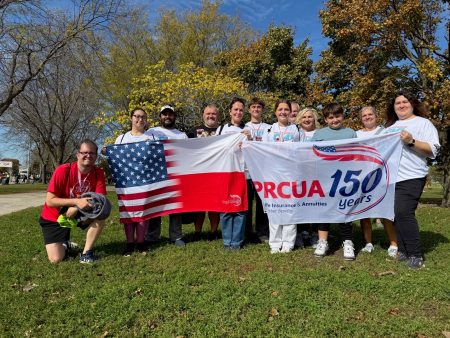
The PRCUA team participated in the 9th Annual Polish Independence Run on Sunday, October 25, at Montrose Harbor in Chicago, Illinois. The event was honoring the Polish heritage and the shared spirit of freedom in both Poland and the United States. President Agnieszka Bastrzyk and Secretary-Treasurer Julie Prado and their families represented PRCUA alongside many of our PRCUA members.
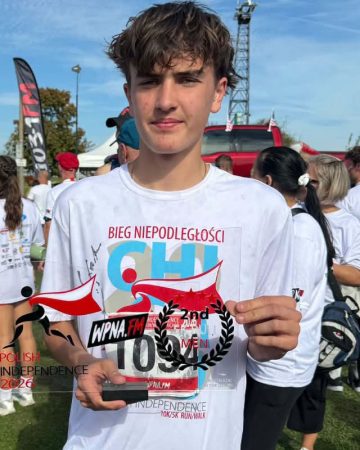 We had special cause to celebrate this year, as Jakub Chrobak, student of PRCUA-sponsored Jan Karski Polish School in Palos Heights, Illinois, took second place overall in the men’s division, running the 5K in just over 17 minutes! Amazing achievement, Jakub! Bravo!
November 11: A Short History
Polish National Independence Day, celebrated on November 11, is one of the most important national holidays in Poland. It commemorates Poland regaining its independence in 1918, following 123 years of foreign rule, during which the country was divided among three powers: Russia, Prussia, and Austria.
The Polish-Lithuanian Commonwealth—once an enormously powerful state—began to lose its independence in the 18th century due to internal conflicts and external pressures. In 1772, 1793, and 1795, Poland underwent three partitions carried out by its neighboring powers. Following the third partition, Poland ceased to exist as an independent state on the map of Europe.
For over a century, Poles lived without a state of their own, yet they never abandoned the hope for freedom. During this period, numerous national uprisings took place—including the November Uprising (1830–1831) and the January Uprising (1863–1864)—and clandestine pro-independence organizations were active. Poles also fought to preserve their culture, language, and national identity, despite intensified efforts at Russification and Germanization.
A turning point finally arrived at the end of World War I. The defeat of the occupying powers, combined with political shifts across Europe, created an opportunity for the restoration of an independent Polish state. On November 11, 1918—the day of the armistice that ended the First World War—Germany signed an armistice with the Entente powers, marking the end of years of warfare and the beginning of a new order in Europe. On that same day, Marshal Józef Piłsudski assumed military authority in Warszawa, Poland’s capitol, signaling the return of Poland to the map.
Today, November 11 is celebrated throughout the country. The day features numerous state ceremonies, patriotic marches, religious services for the nation, and the laying of flowers at monuments and the graves of national heroes. The central observances take place in Warszawa, where the President of the Republic of Poland lays a wreath at the Tomb of the Unknown Soldier in Piłsudski Square. The ceremonies are attended by the country’s highest-ranking officials, the military, social organizations, and scouts. In many cities, local events are also organized—patriotic concerts, historical reenactments, independence-themed runs, exhibitions, competitions, and educational projects for young people. It is a time when Poles, regardless of their political views, can come together to express their patriotism and respect for history.
In recent years, the “Independence Run” has gained increasing popularity; it takes place in many cities (including Chicago), with participants often wearing white and red—the national colors—or carrying Polish flags. This is a form of active celebration that combines sports, tradition, and a sense of national community.
Independence Day is not merely an occasion to commemorate a historical event; it is also a moment for reflection on the contemporary meaning of freedom and sovereignty. In a world fraught with political tensions, conflicts, and global challenges, remembering the arduous path toward independence serves as a reminder of how precious—and fragile—freedom truly is.
For many Poles, November 11th is also a day of personal pride and a sense of belonging. Although Poland’s history has often been tragic, it was precisely during the most difficult moments that the nation proved capable of uniting and fighting for its rights. The Independence Day celebrations serve as a tribute to those who sacrificed their lives for the good of the homeland.
National Independence Day stands as one of the cornerstones of Polish national identity. It serves as a reminder of the heroism, determination, and belief in freedom that inspired successive generations of Poles for over a century. It is a day to pause for a moment, look back, and reflect with pride upon the journey our country has traveled—from its collapse to its full rebirth.